
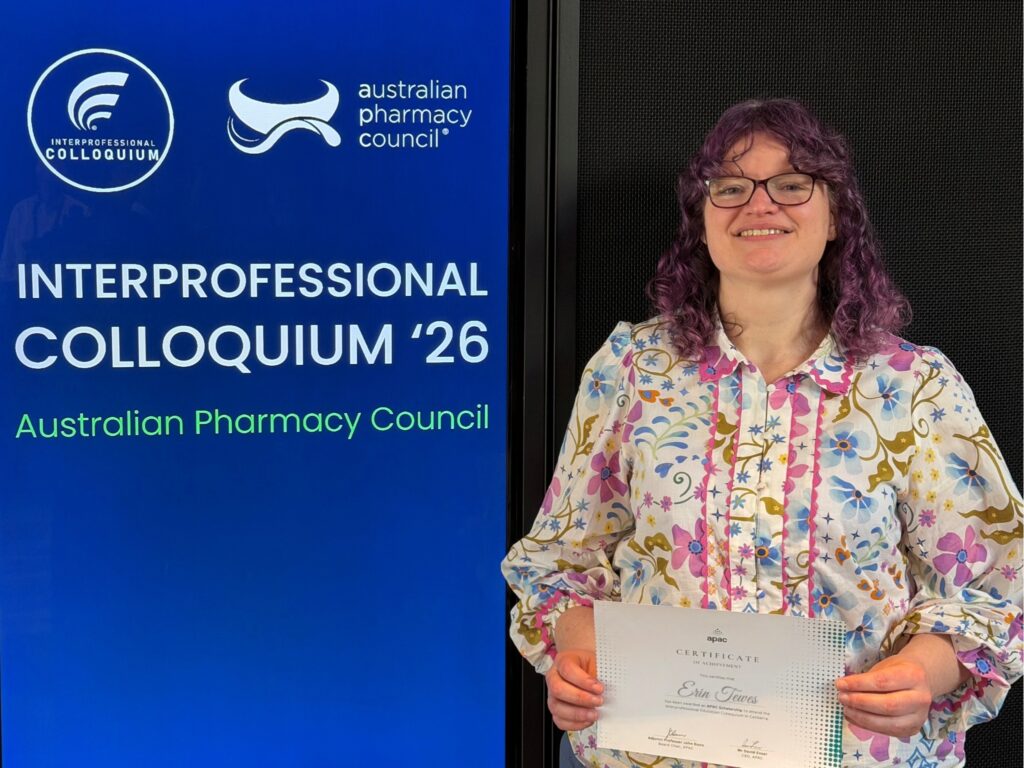
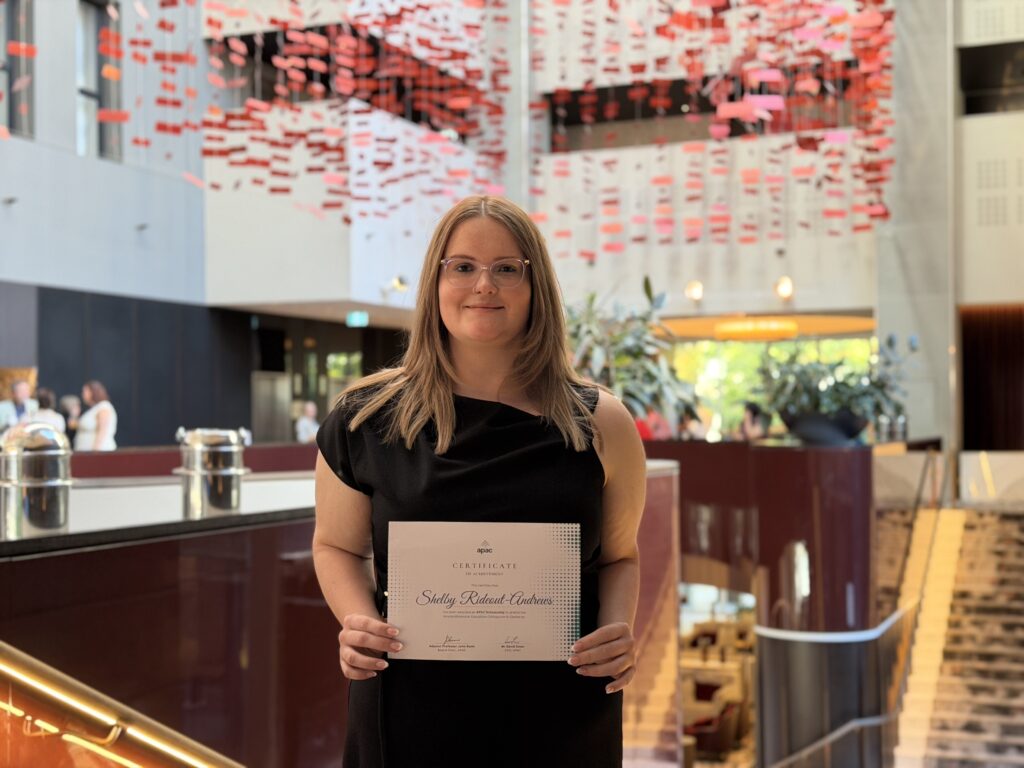
When APAC supported Erin, Myles and Shelby to attend the 2026 Interprofessional Education Colloquium in Canberra, the aim was clear: to ensure emerging voices were part of national conversations about health professional education, accreditation and interprofessional practice.
Hosted by the Australian Pharmacy Council (APC), the Colloquium explored the theme “Empowering Voices: Educating Health Professionals for Respectful and Inclusive Conversations.” For the APAC-sponsored students, the experience offered more than exposure to a national professional forum. It prompted reflection on how future health professionals are taught to communicate, collaborate and understand the people they serve.
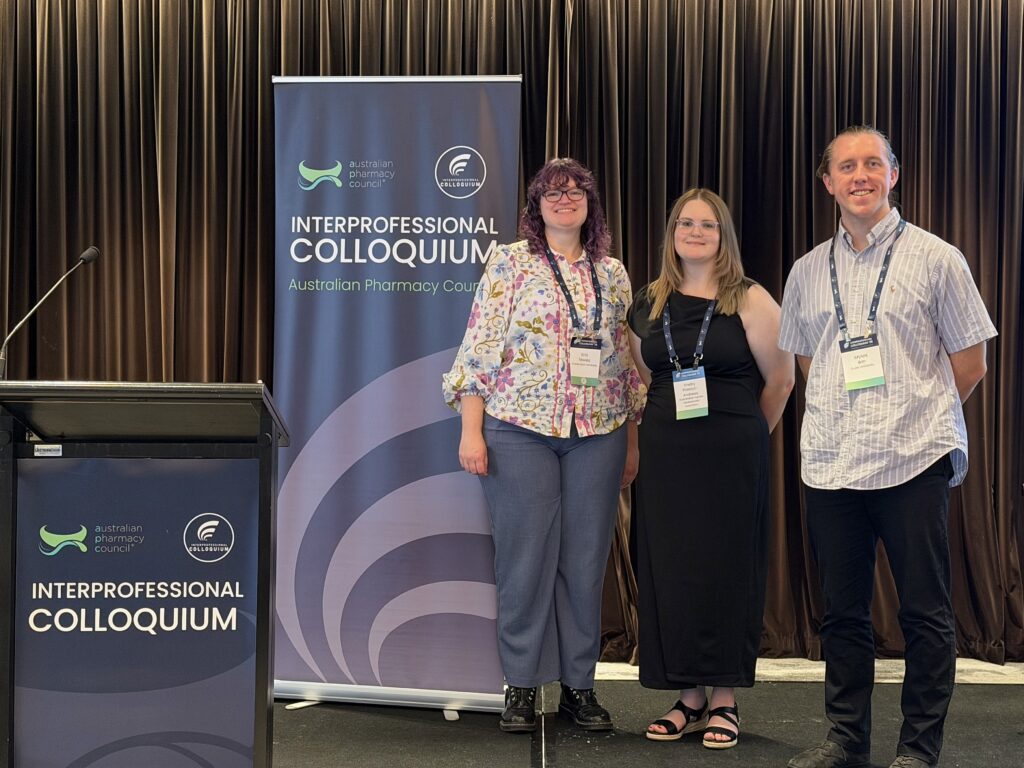
Myles was struck by “how much expertise was present in the room, including lived experience expertise”, and how strongly the value of student partnership came through across the day. Shelby reflected that the Colloquium felt “like walking into a safe space where people’s titles mattered far less than their stories”, with lived experience shaping the tone of the event.
This article brings together their reflections on what they heard, what challenged their thinking, and what they will take into their future studies and practice.
—
Inclusive Communication as Practice, Not Performance
The theme of respectful and inclusive conversations resonated strongly across the students’ reflections.
For Erin, the day reinforced that inclusive communication is not simply about good intent or symbolic gestures. Reflecting on presenter Hannah McPierzie’s experience of waking after brain surgery to find “I SPEAK AUSLAN” written across her bandage, despite preferring written communication in that context, Erin observed that the example captured a wider lesson from the day.
“Inclusive communication is not about performance,” she reflected. “It is about actually asking people what they need and delivering on it.”
Shelby drew a similar lesson from the day, noting the harm that can come from assumptions about how a patient prefers to communicate, what they understand, or how quickly they process information. For her, the experience reinforced the need to treat communication as something “co-constructed with the person in front of me”, rather than something simply delivered by a professional.
A quote from presenter Blayne Arnold resonated most for Myles, with practical application across many areas of professional life. “Changes are best made when they are sustainable, incremental and meaningful”.
Together, their reflections point to a central lesson from the Colloquium. Respectful communication requires humility, curiosity and a willingness to check assumptions. It also requires health professionals to recognise that patients are experts in their own lives.
—
Thinking Beyond Discipline Silos
The Colloquium also prompted students to think more deeply about psychology’s place within interprofessional education and collaborative health practice.
Erin noted that interprofessional dynamics are already actively taught in other allied health fields, including how students are trained to navigate disagreement, hierarchy and escalation in clinical sessions. For Erin, this raised an important question, “where does psychology fit within interprofessional practice, particularly in settings such as outpatient care, hospitals, aged care and the NDIS?”
Professor Jennifer Smith-Merry’s keynote on psychosocial disability and the NDIS was especially significant in this respect. Erin reflected that, in fragmented support systems, psychologists may play a central role in helping clients navigate care, particularly where there is no clear team structure around the person. In that context, interprofessional practice is not an optional extension of psychological work. It is part of understanding the system around the client.
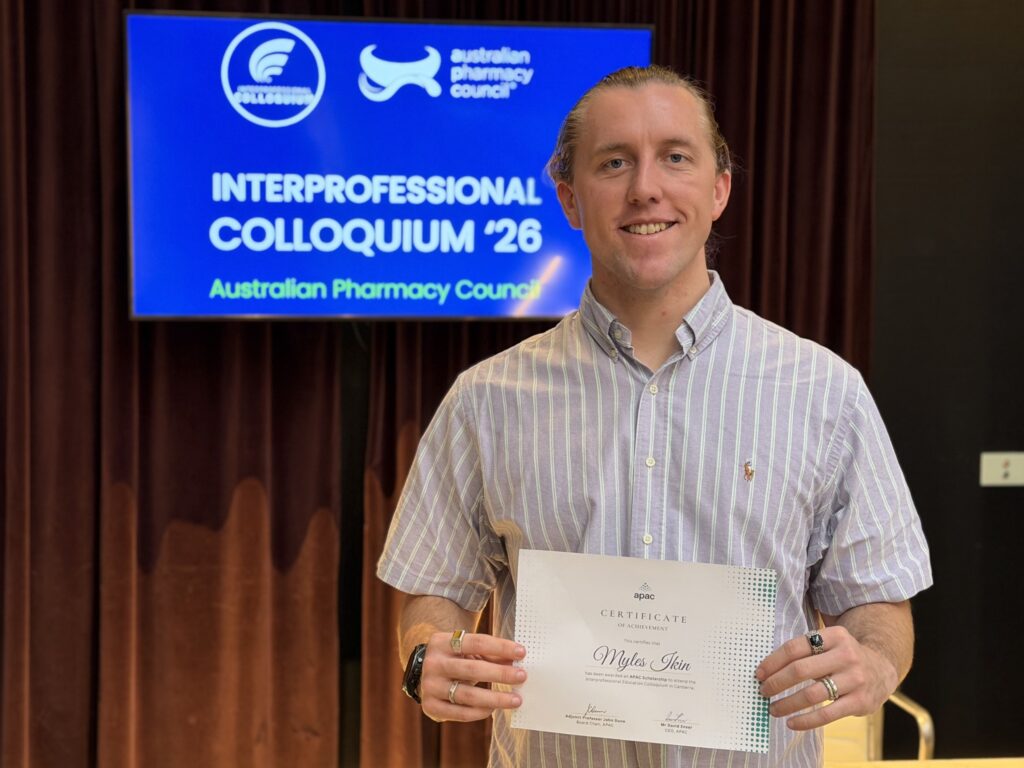
“Interpersonal skills are the bread and butter of psychological practice,” Myles reflected. “I see a real opportunity for the psychology discipline to share this knowledge and skills with other health professionals.
Shelby offered a complimentary view, reflecting that psychology carries a “dual responsibility”, supporting patient wellbeing and behaviour change, while also helping to shape the relational and communicative culture of interprofessional teams.
Each reflection noted that psychology has something distinctive to offer interprofessional education, not only as participating discipline, but as a field with deep expertise in communication, systems, power dynamics, behaviour and relational safety.
—
From Academic Learning to Real-World Practice
A further theme was the gap between academic learning and the emotional, relational and practical demands of clinical work.
Dr Rebecca Waters’ presentation on simulation-based learning in occupational therapy education stood out strongly to Erin and Myles. Both reflected on the value of structured simulation environments, where students can practise complex clinical interactions, receive feedback and try again without putting real patients at risk.
Erin connected this directly to psychology education, observing that counselling requires sustained presence and responsiveness in ways that academic study alone cannot fully prepare students for. Practising with peers, they noted, is not the same as working with a real client, particularly because of the dual relationships involved.
Myles left with ideas about how similar approaches could support pre-placement preparation in psychology and interprofessional education, including intensive simulations that help students make better use of placement learning.
All students noted the importance of ensuring learning environments that allow students to practice, make mistakes and build confidence prior to entering professional settings. As Erin put it, the difference between knowing what good communication looks like and being able to do it “in the room with a real person” is significant.
—
Student Voice as a Contribution, Not an Afterthought
For Erin, Myles and Shelby, attending the Colloquium was also personally meaningful.
Erin reflected that being selected was a signal that their perspective was valued, particularly as a graduate diploma student who came to psychology through a career change. Myles, from a regional and low socio-economic status (SES) background, noted that opportunities like this are not always easily accessible, and that meeting people involved in accreditation and education quality made APAC feel less abstract. For Shelby Rideout-Andrews, the sponsorship represented something larger: reassurance that lived experience belongs alongside research and clinical expertise, rather than outside it.
Across their reflections, the students described feeling welcomed, challenged and energised. They left with new ideas for research, clinical practice, curriculum design, tertiary education and policy. They also left with a stronger sense that psychology has an important role to play in interprofessional education.
For APAC, supporting student participation in the Colloquium was about more than attendance at a single event. It was about helping future psychologists engage early with the broader systems, responsibilities and conversations that shape safe, inclusive and effective health practice.
As these reflections show, students are not only future members of the profession. They are already thinking critically about how health professional education can better prepare practitioners to listen, collaborate and care.
—
Editors’s note: Student reflections have been lightly edited for clarity and length.